
Ocean Pulse
How artist Sean O'Brien created a new way to check the surf
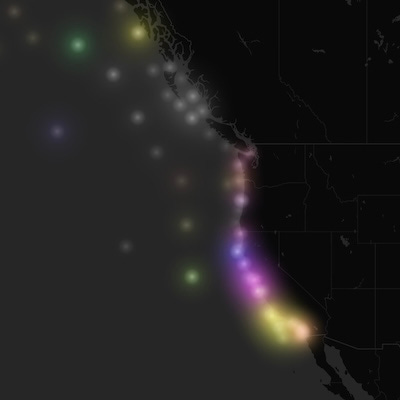
My friend Sean O’Brien is an artist and surfer with a very big brain. Recently, he created an app that transforms the data from NOAA buoys into a lightshow in your pocket.
It also turns out to be a very fun way to check the surf. Clicking each dot of light pops up the swell size, direction, and period, direct from the buoys bobbing around out there in the ocean.
Check out the app: https://apps.apple.com/us/app/ocean-pulse/id6759033100
A few years ago, I wrote a story about Sean for The Surfer’s Journal. At the time, he’d created a series of digital art works called “Ocean Pulse,” which offer a mesmerizing view of the ocean’s swells represented with light. Read on, for the evolution of this radical project and Sean’s vision as an artist.
“The pieces that resonate with me most are the Harvest pieces, which are just a beacon of light representing one buoy. You’re just getting the data from that source, very abstracted in terms of what it is, and you can process it and build a relationship with it over time.” — Sean O’Brien
Each morning artist Sean O’Brien sat down at his kitchen counter in Berlin and checked the surf in California. “In Santa Barbara, I would wander out each morning with my coffee in hand,” he says. “I loved being connected to that rhythm, becoming more and more in tune with what the ocean had to tell me.”
Inspired by those feelings of connection and ritual, O’Brien created “Ocean Pulse,” a series of digital art works that use light to represent the ocean’s swell patterns.
The first time he stood up on his self-shaped longboard, O’Brien fell in love with surfing. Daily surf checks set the pattern of his life until a move to Berlin with his wife Heike Schirmer left him landlocked.
While in Berlin he did a show of surf photos printed on Hard Rock Maple wood. In each image the ink sinks into the wood, soft and faded, and creates a reminiscence of his life in California. At night, a recurring dream haunted O’Brien with a vision of an ocean he could never quite reach.
Each morning he sought connection in the buoy data and swell graphs that described the faraway Pacific. Still, the practice felt incomplete to him. “I didn’t like the screen as my medium to connect with the ocean,” he says. “How do I connect to the ocean that doesn’t involve a screen or a device in my pocket?”
When O’Brien looked at his phone, he saw the strings of numbers the buoys provided, but the deeper connection he felt checking the surf each day eluded him.
Art has a way of communicating the abstract and the intangible, and of distilling ideas and emotions. Back in California, O’Brien sought to tell the story of his daily surf check, a central ritual of his life and the emotions of connection and curiosity it evokes. Light offered the obvious medium. “It is elegant that light is a wave form,” he says. “So I used a wave form to describe another wave form.”
Five pieces comprise “Ocean Pulse” and illuminate different areas of the California coast. Built into each piece is a micro-processor with an internet connection. Code written by his dad Michael O’Brien, brother Travis O’Brien, and friend Dan Loman pulls data generated by NOAA’s offshore buoy network. Then “Ocean Pulse” transforms the data into light.
“Definitely the part that took the longest was creating a really good color map for swell direction,” O’Brien says. “I took a color wheel and imagined it laid over a compass rose.”
He chose blue for north, red for west, and yellow for south. Occasionally, an intense off-shore wind will light up a single buoy in green: a rare east swell. Much like a devoted surfer learns the lineup, daily interaction with “Ocean Pulse” reveals the ever-changing rhythms of the ocean’s wild dance.
Ocean Pulse reflects O’Brien’s preoccupation with curiosity. A desire to provoke questions and reflection links “Ocean Pulse” with his street art and with “Machina creanda,” a series of mechanical sculptures that create intricate drawings.
Someday, O’Brien hopes to install a larger version of “Ocean Pulse” in a public space to provoke conversation and reflection.
“If my art work has caused someone to pause, and get curious, and look a little harder, I feel like I’ve done something. Then the work starts to tell its own story.” ✨